Why I sell my apps through Polar (and why one of them uses Stripe instead)
For a one-person company in Poland, the hardest part of selling software worldwide isn't the checkout. It's VAT. Here's why most of my apps sell through Polar as merchant of record, and why Sidecue uses Stripe's merchant-of-record mode instead.

Michal Wlosik
· 3 min read
Part of how I market my apps as a one-person team.
Payments don't sound like marketing, but they decide how fast I can launch a paid product and how much of my week goes to paperwork instead of selling. I run a sole proprietorship in Poland, I'm a VAT payer, and my customers are mostly individuals all over the world. That combination makes one question more important than any checkout design: who is legally selling to the customer?
Option 1: plain Stripe, where I'm the seller
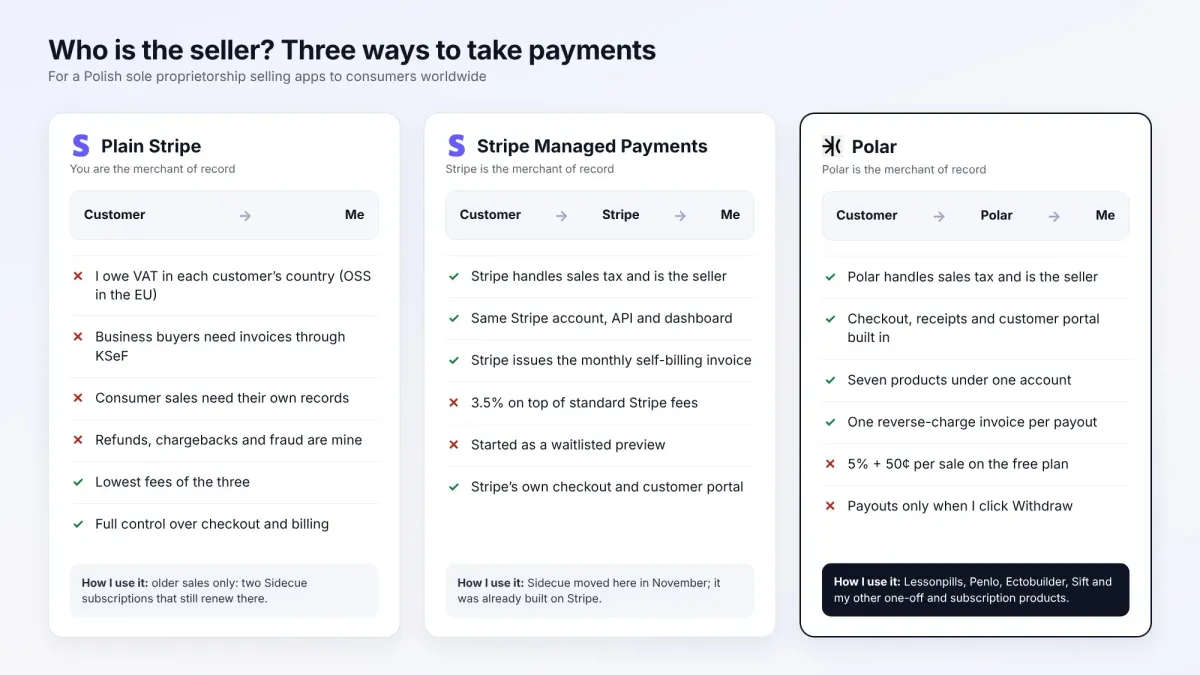
With a normal Stripe account, I'm the merchant of record. Stripe moves the money, but legally I sell to each customer. For a Polish company selling digital products to consumers, that means:
- VAT at each EU customer's local rate, reported through OSS, and tax rules in other countries too.
- Invoices for business buyers, which in Poland now go through the national e-invoicing system, KSeF.
- Separate records for consumer sales.
- Refunds, chargebacks and fraud are my problem.
It's the cheapest option in fees and the most flexible, and for a company with an accountant and a finance process it's fine. For one person shipping several small apps, it's a lot of overhead per sale.
Option 2: Polar, where Polar is the seller
Polar acts as merchant of record. The customer buys from Polar, Polar collects and pays the sales tax, and Polar pays me. From a tax point of view I have one customer, Polar Software, Inc., and I issue one invoice per payout: a reverse-charge invoice to a US company, sent through KSeF like any other.
That's why most of my paid products sell through Polar: Lessonpills, Penlo, Ectobuilder and Sift among them. What I get:
- No per-country tax work. One invoice a month instead of a VAT position for every country.
- Checkout, receipts and a customer portal out of the box, for one-time purchases and subscriptions.
- Many products, one account. I have seven organisations in Polar, one per product.
- Good tooling for automation. Polar has an API and an MCP server, so Claude can read orders. The Sift review emails in the email post start from Polar orders.
The trade-offs: it costs more than plain Stripe (Polar's free plan currently takes 5% + 50¢ per sale, with lower rates on paid plans), and payouts happen when I click Withdraw rather than on a schedule.
Option 3: Stripe Managed Payments, where Stripe is the seller
To be fair to Stripe: it now offers the same model. Stripe Managed Payments makes Stripe the merchant of record on your existing account. Stripe handles sales tax, you keep the same dashboard, API and checkout, and at the end of the month Stripe issues the self-billing document you need for your books.
Sidecue uses it. Sidecue was already built on Stripe, and I didn't want to move it to Polar, so when Managed Payments became available on my account, I moved Sidecue's sales there in November. Two older subscriptions still renew on the original plain Stripe account.
The trade-offs: Managed Payments adds 3.5% on top of standard Stripe fees, which puts it in the same range as Polar. It also started as a waitlisted preview, so check whether it's available in your country before planning around it.
How I choose
- New product, no existing billing: Polar. Fastest to set up, and one account covers everything.
- Product already built on Stripe: Stripe Managed Payments, to avoid a migration.
- Plain Stripe: only for sales that are already there. If you're a solo founder in the EU selling to consumers, I wouldn't start there.
Other merchants of record exist too, Paddle being the most established. I looked at them for Sidecue; Stripe's own option won simply because nothing had to move.
The bookkeeping, automated
A merchant of record doesn't remove bookkeeping, it shrinks it. Each month I still need an invoice for every Polar payout and the right documents for Stripe. Claude built me a small app, Payouts Hub, that reads payouts from Stripe and Polar through Composio and drafts the matching invoices in my invoicing system. I review them and send them to KSeF myself.
Written by
Builder, product marketer and AI enthusiast. I ship my own apps, like Sift (siftphotos.pro), Penlo (penlo.app), Ectobuilder (ectobuilder.com) and Cubbie (cubbie.pro), and write about building and marketing them with AI.
Keep reading

How I market my apps as a one-person team, with Claude as my marketing department
I build and market close to ten apps on my own. Here is the whole system: real numbers from Search Console, research in Ahrefs, product sites in Ectobuilder, store listings, email in Resend, payments in Polar, and Claude wiring it together.
How I launch a product site and blog in an afternoon with Ectobuilder
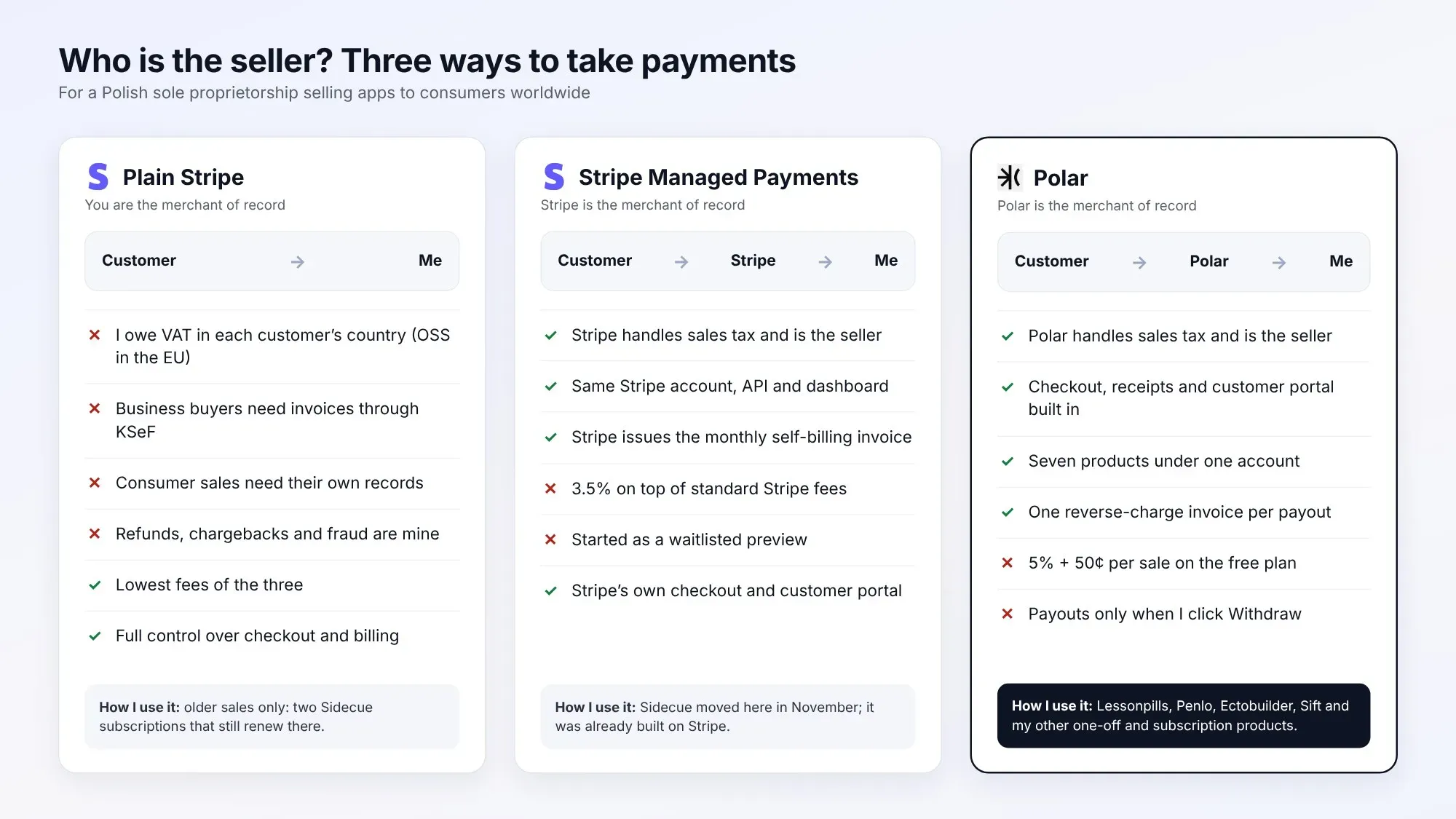
Every product I ship gets its own site and blog on Ghost, designed in Ectobuilder. Here's the setup, and how Claude edits, screenshots and writes for those sites through Ectobuilder's connector.
How I use Search Console, Ahrefs and Claude to plan content for Google and AI search
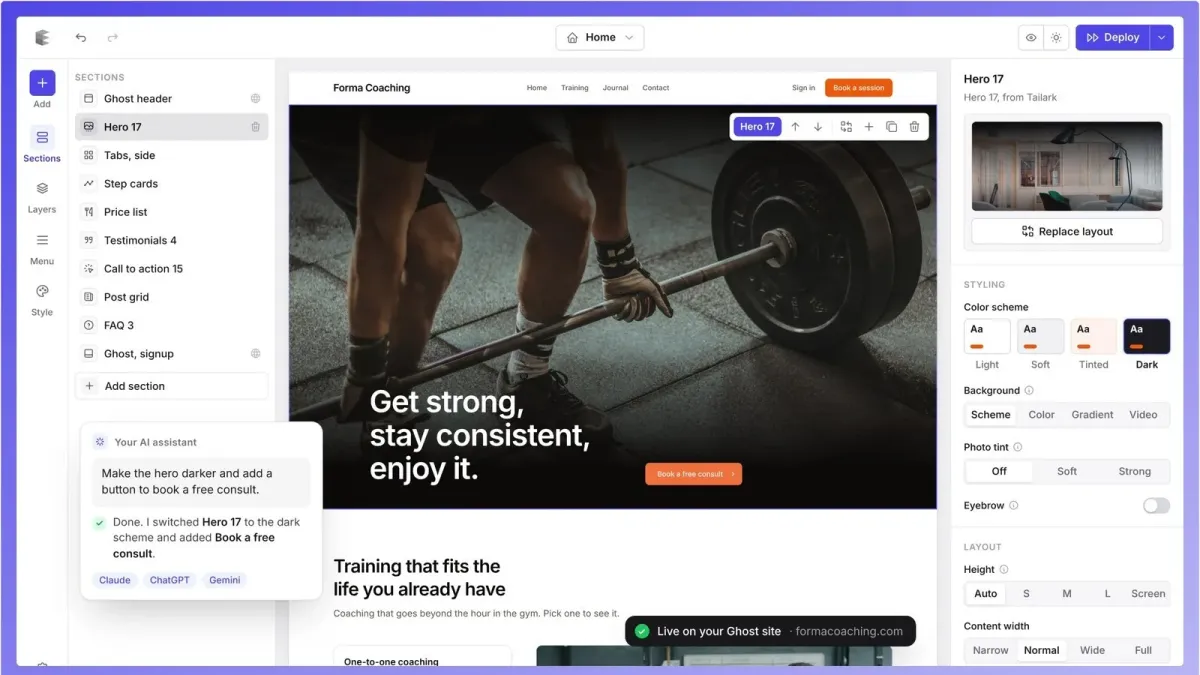
Claude reads Search Console for what's actually working and Ahrefs for what's worth writing next. Here's the loop I use to plan content for Google and for AI assistants, with real data from Penlo.